Warning - Life is Dangerous and Slippery
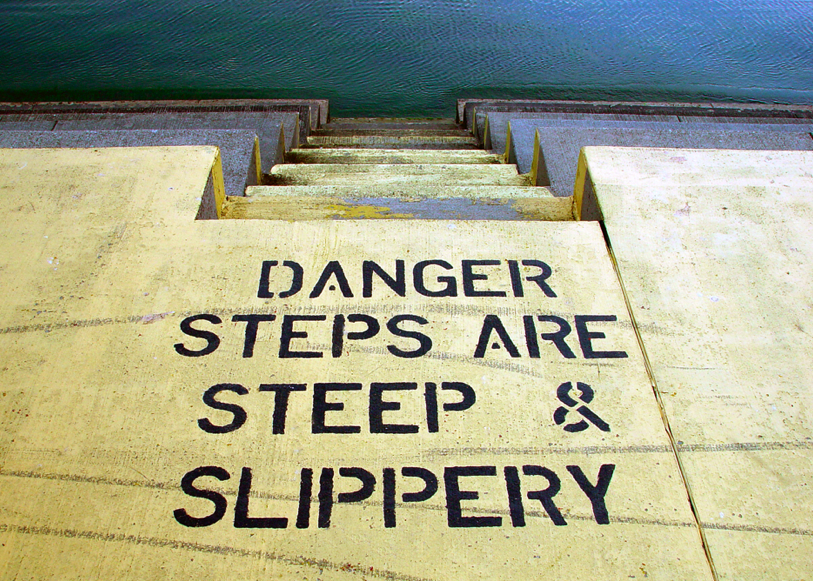
I’m a risk taker. I always have been, even as a toddler. As I’ve gotten older the risks have turned from rock climbing, kayaking, hiking and motorcycles to things like intimacy, making friends, being vulnerable - emotional risks. I prefer jumping out of a helicopter on the end of a rope any day. At least once you hit the ground, it’s over - except for the adrenaline rush that feels so good. Emotional vulnerability is like the steps to the pool….slippery and dangerous and meant to be taken with care - not avoided, but approached with caution and awareness.
Emotional intimacy, failing, looking foolish, being vulnerable and exposing our thoughts and feelings and lives to others is a lot riskier. Not only can they hurt us, but they can keep on hurting us. A vulnerable spot, thought or weakness becomes an eternal weakness. Better to hide who we are if we want to be safe. Except - scientists now know that leads to heart attacks, strokes, cancer and depression. If you want to live life, and live it fully and completely, you’ve got to learn a couple of important things. You’ve got to learn to tell the safe people from the unsafe people.
What do I mean by a “safe person”? I mean someone who will respect us, help us growth mentally, emotionally and spiritually, and who won’t deliberately and repeatedly betray us, hurt us, shame or humiliate us. A safe person is the kind of person we all want as a friend or co-worker or boss. A safe person “plays well with others.” So who is safe? Safe people are those we can trust. You rarely meet them in places where untrustworthy people hang out - like bars, crime scenes and so on. You know that.
You might meet them in church, or at work, or your family reunion, but there are no guarantees. Because safe people don’t wear badges. A clean, shiny outside doesn’t mean the inside is the same. You can’t judge a book by its cover and an unsafe person can appear safe at first glance. So how can you tell?
You come to know safe people over time. You trust them a little bit and they come through for you. They trust you, and you come through for them. It’s like building a structure made of time, sharing and emotions. You can build a tent (summer camp friends), or a shed, or a rancher or a castle of a friendship. But it takes time. You don’t do it in a day, a weekend, or year. In battle, or under stress you may forge a bond - but friendships with safe people? Friendships take time, trust, effort and being vulnerable. And along the way - even if you’re building a relationship with a safe person you will get hurt. Guaranteed. That’s just life. We’re imperfect. It happens. But when it happens with safe people, you work through it. You learn from it. You smooth the bumps and the rough spots. And in time the ride and the relationship is golden. Not so with an unsafe person. With an unsafe person you feel increasingly worse about the relationship as time goes on - not better about it.
But there are other ways to tell safe from unsafe.The secret is to not give up. The secret is to learn who is safe, who isn’t and how to listen to your intuition. It sounds complex, but it’s not really. You just have to ignore what feels familiar and start looking at the facts. There are criteria that define what safe is.
Safe people respect you. They respect your boundaries, your secrets, your confidences and your feelings. If they make a mistake, they apologize and they don’t do it again. Lots of people will apologize and say they’ll stop the behavior that hurts, but they keep doing it. They’re not safe. Watch their actions, not their words.
Safe people listen to you when you express a boundary, or a disappointment, or tell them what they have done to hurt you. They don’t get defensive. They listen. If they see your point, they apologize - no excuses. They own their behavior. If they don’t see your point and don’t think they did anything wrong - they ask for clarification. “I’m not sure I understand what you’re trying to tell me, but you matter to me. Can you give me a specific instance? Can you explain it another way? Can you tell me more about what exactly about that is so upsetting? How can I change?” And if changing is within their power, and doesn’t violate their own boundaries - they’ll do it. They work with you, not against you.
For instance, I have (had) a friend who smokes. I hate the smell of cigarette smoke. I’ve asked her not to smoke when we go to dinner, or to smoke outside while I finish my meal smoke free. She agrees to do it - but then lights up while I’m still eating and she is finished. We don’t go to dinner anymore unless it is a non-smoking restaurant. She doesn’t really care about my boundaries - only about her addiction. When I point out she promised not to smoke she attacked and belittled me, trying to intimidate or shame me into shutting up. Which I did…but I went home steaming and angry. That’s not a friendship.
She was smart and funny and I enjoyed her company, just not her cigarettes. I still liked her enough to socialize in non-smoking environments, and the occasional smoking environment, but I don’t like to smell like an ashtray so I avoided doing too much with her. She moved to Texas last spring. Richmond was becoming too anti-smoking for her. She’ll be happier out west. She also couldn’t keep a secret, laughed at my dreams and once told me she wouldn’t think of herself as fat until she weighed more than me. It took me a while to see how she disrespected me. But eventually I did. I only saw her twice this year and I think I won’t see her again. She’s not a safe person. But she was an old friend I’d known a long time and I mistook feeling something familiar with feeling something safe. We often get into relationships because they feel like what we’re used to - familiar - and we mistake that familiar feeling for feeling safe. It’s not. And we can really like an unsafe person. Many of them are funny, charming, talented and great people - except they’re not safe for us. We don’t walk away feeling better for being with them, but feeling oddly unsettled - like there’s something there we can’t quite put our finger on….
Life and friendships are hard enough with safe people, let alone unsafe ones. Those of us who grew up in dysfunctional families are at a disadvantage of sorts. We’ve learned later in life than most what “safe” and “not safe” people are. I’m learning it at 54!!! So, I wanted to share what I’ve learned so far.
Safe People:
Safe people encourage us to be who we are.
Safe people respect our boundaries.
Safe people don’t argue with us when we say “No,” to things we don’t want to do.
Safe people don’t manipulate, shame or guilt us into doing things because they want us to.
Safe people love us.
Safe people are honest with us.
Safe people don’t “one up” us or try to be our parent or our child. They realize we are equals in our relationship. They share their joys and faults or failures in appropriate ways and to the degree that we share with them. A safe relationship is NOT one sided - with only one person being vulnerable and the other being the “strong, together one”.
Safe people are real. They admit their faults and they strive to change and grow and heal wherever they are - realizing none of us is perfect.
Safe people are humble. They know they don’t know everything and they’re open to learning from anyone.
Now, this doesn’t mean safe people won’t confront us in love when we’re screwing up. If they see us doing something wrong, or we tread on their boundaries - they’ll tell us - gently and firmly, addressing the action, not the person.
Maybe it’s easier to recognize the unsafe people in our lives:
Unsafe people are inappropriately critical.
Unsafe people try to control us.
Unsafe people don’t have or respect boundaries, or have shifting or poor boundaries.
Unsafe people lie to us, often without reason and often when telling the truth would be easier.
Unsafe people can’t be trusted - to show up, to keep a promise, to be supportive, or to follow through.
Unsafe people are angry people. Angry at life, angry at us - but rarely at themselves.
Unsafe people need to have someone to blame.
Unsafe people rarely accept responsibility for their actions or words.
Unsafe people have an addiction - drugs, alcohol, gambling, sex - something that comes before family, friends and you.
Unsafe people demand trust without earning it. They want you to trust THEM immediately, but they rarely trust anyone else.
Unsafe people are critical and judgmental.
Unsafe people believe their way, faith, religion, dogma, political belief or way of doing something is the ONLY way and they are judgmental and critical of those who don’t believe, think or feel as they do.
Unsafe people think they have it all together - their sh*t don’t stink - is the common phrase.
Unsafe people are intolerant.
Unsafe people are defensive. They refuse to listen to feedback, honest critiques or suggestions about how they act or their impact on people.
Unsafe people betray our secrets and belittle our dreams.
Unsafe people avoid working on their issues rather than dealing with them.
This is by no means an exhaustive list. But it’s a start. Once you identify unsafe people in your life the next step is to decide what kind of relationship you want to have with them. I decided to either back off, get rid of, or learn to accept each person based on a complex set of criteria. My blabbermouth friend I only tell the good news because I know whatever I tell her in confidence she’ll tell 20 people within the hour after she leaves me. She has a compulsive need to spew everything anyone tells her. She’ll promise to keep a confidence, but can’t. It’s cost her a lot of good friends over the years - safe people who see her for what she is and who take care of themselves. As long as I remember talking to her is like posting my words on the internet or Twitter I’m okay. She’s not mean…just clueless and hurting and unwilling to change. But we have lunch a couple of times a year and I’m okay with that.
You have to decide for yourself what matters, what kind of relationship you’ll have. It’s hard to get away from unsafe co-workers or classmates, or teammates, but you can learn how to act around them. You can learn to not talk to them about things that they could use to disappoint or hurt you. You can distance yourself from them, set boundaries and consequences. You CAN control your own life. Don’t try to change them. That never works. Control YOU.
And once you’re on your way, you’ll notice the difference in the quality of your life. But you’ll notice that life is still painful. People will still disappoint, hurt or betray you in ways that feel unsafe. The difference is - safe people will work with you to change and correct it. That’s the best you can ask for.
So remember, the steps to the water are dangerous and slippery, but take your time, navigate them carefully and you can be swimming and enjoying the water sooner than you thought! Here’s to safe people!!