It’s all fun and games until someone loses an eye
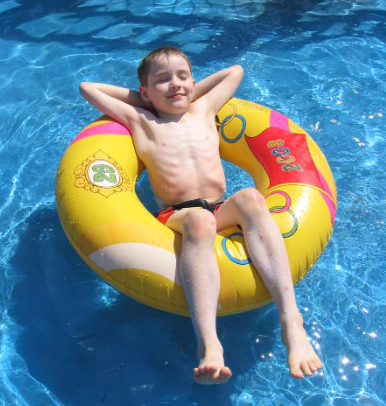
The screams of 10-year olds travel far. And like all mothers in the animal kingdom, especially those in the human kingdom, a mother of pre-tweens can single out the wail of her children across the expanse of a public swimming pool of wall-to-wall floats, bodies and shrieking girls without batting an eye.
“Oh no,” she said. “Christopher’s been hurt. She sighed – interrupting our conversation and turning to look over her shoulder at the pool.
“How can you hear anything?” I said listening to the roar of kids, splashing and whistles blowing behind her. I was amazed, but truly wondering more if she’d been listening to me at all.
“I was listening to you,” she smiled.
Mothers are also mind readers. I want to go to that school – wherever it is they go, or get a copy of the manual they are all issued when they become mothers. Why? Because the next words out of my friend’s mouth when Christopher came up crying and holding his bloody nose were, “Sure, it’s all fun and games until someone loses an eye.” (My mother said that. My mother’s mother said that. Now my friend was saying it. There has to be a book somewhere.)
“It’s not my eye, it’s my dose,” he said stuffily, dripping blood on our towel.
“What I meant was, well, never mind, tilt your head back.”
As my friend tended to her bloody child I thought about the phrase:
“It’s all fun and games until someone loses an eye.” Later I looked it up on the internet and learned it allegedly originated in ancient Rome - where the only rule during wrestling matches was - “No eye gouging.” Everything else was allowed. The only way to be disqualified was to poke someone’s eye out. Of course by the time someone loses an eye, it’s too late for them. Survivor’s guilt kicks in. Everyone is truly sorry for the loss and secretly glad it wasn’t them. But the blind warrior still has to live with their decision. They can sit around and blame whoever they want, but as Christopher was learning, our decisions – good or bad – have consequences. And, whatever the outcome is, accepting it and dealing with it is part of life.
As Christopher’s tears, sobbing, whining and his blood abated Jane asked, “What were you doing?” Christopher tried to explain who had hit him in the nose and cast blame, but Jane wasn’t having any part of it. She kept repeating, “What were YOU doing?” Well, he and his friends were rough housing and his nose got in the way of someone’s elbow in the mix of bodies flailing around on the grass.
“And whose decision was it to play with David and Clay?”
“Mine.”
“And if you hadn’t been rough housing?” He shrugged. Obviously he’d had this conversation before. She waited.
“I wouldn’t have gotten hurt,” he sighed.
“What are you going to do when you go back?”
“Stop playing?” he asked?
“Or?”
“Have fun, but be more careful,” obviously something he’d heard before as well.
With that admission she waved him off – wads of tissue paper still stuck up his nose.
“You took that pretty well.”
“Yeah, well, he’s my third boy. As long as they’re conscious and walking I don’t get too excited if they’re bleeding,” she laughed.
What intrigued me more than her acute sense of hearing and her laid back attitude about the blood was her insistence that Christopher take responsibility for his role in the bloody nose.
“He had a part in it and he needs to see that,” she said.
“I don’t want him growing up blaming everyone else for his decisions or thinking someone is going to rescue him so he gets off scott-free.”
That’s what really struck me. Christopher, “age nine and a half, going on ten” is learning that his choices have consequences, but that they are really his choices and he is responsible for what happens when he makes a choice. He’s learning he can control what happens to him by a pretty significant degree. If he doesn’t do his homework, he’s the one who has to face the teacher, or stay after school, or see his grades affected. His parents don’t rescue him. He gets to experience the full brunt of his decisions. He is also learning that even if he is a totally innocent victim he can still make decisions after the fact to change the outcome – in fact he must take responsibility for outcomes if he wants to deal with the cards life hands him.
When a neighbor backed into his bike last spring it wasn’t his fault. The bike was parked where it was supposed to be, but it was still up to him to get estimates on the repairs and to go over with his father to present the estimates and collect the check from the neighbor. It was his bike so he was still the one who had to go with his father to the bike shop and learn what to do when bad things happen to innocent people. You can sit around blaming and be a victim, or you can take action. Fair? Life isn’t fair. Sitting around and complaining and whining doesn’t accomplish anything. Action does, even if it’s not technically your fault, it’s still your life and that you are responsible for.
It’s a lesson that not many adults seem to have learned. It’s also one of the most valuable lessons Christopher will grow up with. I can’t wait to see how this kid does in college, or in life. He’s already pretty self-confident without being arrogant. It’s something that comes from true self-esteem, not the hyped up “What a great job you did!!” and smiley face stickers that adults put on kid’s papers and projects. It comes from learning, failing and trying again and taking responsibility for his actions – succeed or fail.
I hear from two kinds of people every day – those that blame others for what happened to them as children, and sit back and wait for someone to fix or rescue them; and those who acknowledge what happened to them as children, but who focus on their responsibility as adults to change their lives in the here and now. It’s a subtle difference at first – both were wronged. Both were victims. Both can point to who “did it” to them – whatever it was. But only one knows it’s up them to act.
The big difference is those who own their lives, who act, who heal, who grow, who stop being victims all understand and acknowledge it’s in their power to change their lives. Just as Christopher is seeing that his decisions have consequences for good or bad, and that he can change his outcome with different decisions (have fun, but be careful), we too have the power to change our lives if we own our choices.